Edgerston House
The Rutherfurd estate near Jedburgh in the Scottish Borders.
Rutherfurd of Edgerston
Edgerston is located six miles south of Jedburgh, a charming, historic Border town. It is just a few miles north of the English border. Edgerston House is a magnificent 17th and 18th century country house, which once sat on 3,700 acres of farm land, woods and beautiful rolling hills. When the estate was sold for the second time in 1980 it was divided, the house now sits on 650 acres.
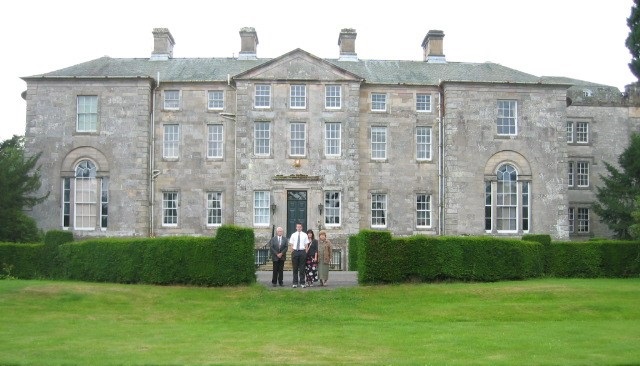
Edgerston was a Rutherfurd estate since at least 1448. Before 1503 it was one of the many estates, and baronies which were controlled by Rutherfurd of that Ilk, which means Rutherfurd of Rutherfurd. James Rutherfurd of that Ilk towards the end of his life tried to make sure that his male heirs would succeed to all of the Rutherfurd properties. In Jedburgh on September 15, 1492 James had a new charter drawn up; this charter lists all of the Rutherfurd holdings and lists his male heirs who would inherit. James’s granddaughters Katherine and Helen Rutherfurd, unfortunately had politically powerful husbands whose influence in a corrupt court was more powerful than the parchment of James’s will. Thomas Rutherfurd, the third son of James, struggled for many years to keep Edgerston. He finally made good his right as male heir but lost the rest of the estates to his niece Katherine Rutherfurd and her husband Sir James Stewart of Traquair. Edgerston was also given to Katherine, but Thomas defied the crown and would not give it up. It was actually three generations of Rutherfurds who struggled to keep Edgerston. At last on January 12, 1559/60 Thomas’s grandson Richard got a charter of the barony of Edgerston from Stewart. Edgerston would probably still be in Rutherfurd family hands if the modern day descendents of Thomas had fought as hard to keep it as Thomas and his son and grandson.
Edgerston House
In 1695 Thomas Rutherfurd (c.1650–1720) built the center part of the present house. It is unclear whether this incorporated or completely replaced the existing tower (c. 1600); however, the initials of Thomas Rutherfurd and his wife Susanna Riddell are said to be carved into one of the dormer windows.
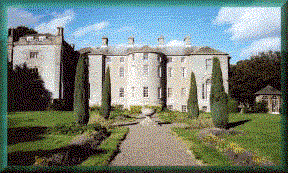
John Rutherfurd (1748–1834) of Edgerston was a great benefactor to Edgerston. In 1793 he built on the two wings with their Venetian windows and the semi-circular tower at the south side of the house. In a letter written by his uncle, Baron Robert Rutherfurd to Walter Rutherfurd, “Fairnington, Oct 28, 1788, Dear Walter, I want to send you a copy of the plan of the improvements that our nephew is making at Edgerston. He is putting on two wings at a cost of 3,000 and when it is completed it will be one of the finest seats in the Shire.” In a letter between the same uncles, “Fairnington, Nov 26, 1792. Edgerston House by being repaired with additions is now one of the handsomest and most commodious of any in this county.”
The final addition to Edgerston was the Tower built by William Oliver-Rutherfurd (1781–1879) in 1840. This tower is a fully equipped house which is now rented.
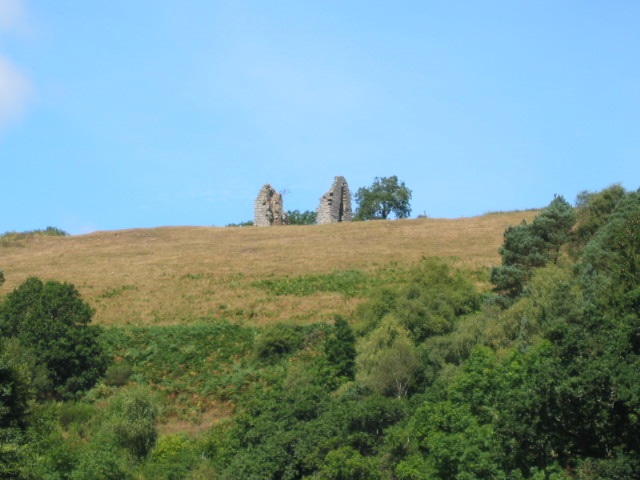
On the hill above Edgerston House can be seen the remains of a peel tower which was used by the Rutherfurds for defense against the Kerrs and other families that the Rutherfurds were feuding with, and as defense against the English.
Border Reivers
Edgerston is just a few miles north of the English Border; so, the Rutherfurds of Edgerston were often the first line of defense against the English. The Scottish Borders is a unique and distinct culture unlike the rest of Scotland because of the violence and turbulence of its past.
Quoting from the book The Steel Bonnets by George MacDonald Fraser,
In the making of Britain, between England and Scotland, there was prolonged and terrible violence, and whoever gained in the end, the Border country suffered fearfully in the process. It was the ring in which champions met; armies marched and counter-marched and fought and fled across it; it was wasted and burned and despoiled, its people harried, robbed and slaughtered, on both sides, by both sides. Whatever the rights and wrongs, the Borderers were the people who bore the brunt; for almost 300 years, from the late thirteenth century to the middle of the sixteenth, they lived on a battlefield that stretched from the Solway to the North Sea. War after war was fought on it, and this, to put it mildly, had an effect on the folk who lived there.
Constant strife, or the threat of it, bred up a race of hard people along the Border lines. They lived in a jungle, and they had to live by jungle rules. This is not to excuse them, but to explain. If a man cannot live, and ensure that his family lives, within the law, he has no alternative but to step outside it. It was inevitable that the way of life which the Borderer had to follow in time of war should be carried over into what was nominally peacetime; habits are hard to break, and here they became so deeply ingrained as to be almost instinctive.
By the sixteenth century robbery and blood feud had become virtually systematic. That century saw the activities of the steel bonneted Border riders—noble and simple, robber and lawman, soldier and farmer, outlaw and peasant—at their height.
In the story of Britain, the Border reiver is a unique figure…. he would probably be described as an agricultural labourer, or a small-holder, or gentleman farmer, or even a peer of the realm; he was also a professional cattle rustler. In addition he was a fighting man who, on the evidence, handled his weapons with superb skill; a guerrilla soldier of great resource to whom the arts of theft, raid, tracking and ambush were second nature.
He was also often a gangster organized on highly professional lines,…He gave the word “blackmail” to the English language…. this practice is probably as old as time, but the expression itself was coined on the Borders, and meant something different from blackmail today. Its literal meaning is “black rent”— in other words, illegal rent— and its exact modern equivalent is the protection racket.
The Borders are divided into six areas, three on the Scottish side and three on the English side, Edgerston is in an area known as the Scottish Middle March. Some of the riding surnames in the Sixteenth century in the Scottish Middle March are; Scotts, Kerrs, Elliots, Douglases, Rutherfords, Olivers, Youngs, Pringles, Turnbulls, Armstrongs. Some of these families were Rutherfurd allies, with others they were feuding. The most notable and longest lasting feud was between the Rutherfurds and the Kerrs.
Source — The Steel Bonnets by George MacDonald Fraser, 1971